
Programme
The 2027 agenda brings you once again in-depth content and relevant topics supported by meaningful business advice.
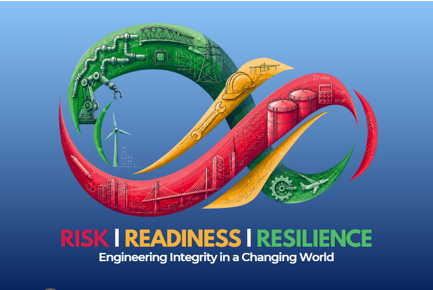
The conference theme of "Risk, Readiness and Resilience: Engineering Integrity in a Changing World" will be fully explored by a roster of industry experts.
Delegates can look forward to a series of thought-provoking papers focused on a diverse range of issues such as:
- Engineering leadership and organisational resilience
- Net zero, sustainability and energy transition
- AI and digital technologies in industry
- Asset integrity, ageing plant and life extension
- Process safety, alarm management and risk control
The programme will also provide ample opportunity to participate in lively debate in the form of interactive workshops, which will be centered on a choice of three conference streams:
- Leadership (sessions A1, B1, C1, D1, E1, F1 & G1)
- Mechanical, Pressure and Structures (sessions A2, B2, C2, D2, E2, F2 & G2)
- Electrical, Instrumentation and Control (sessions A3, B3, C3, D3, E3, F3 & G3)
Day One - Wednesday 21 April 2027
| Time | Description | Location |
|---|---|---|
| 09:00 - 09:50 | Registration, Professional Networking, Exhibition |
|
| Opportunity to visit the exhibitor stands and catch up on what’s happening in your industry | ||
| 09:50 - 10:00 | Welcome |
|
| 10:00 - 10:50 | Keynote 1: Engineering integrity in a changing world: What leaders must get right now | |
| This keynote will explore how engineering leaders can maintain integrity, safety and resilience in an increasingly complex operating environment. Drawing on lessons from major global events, industrial transition, ageing assets, supply chain pressures and emerging technologies, the session will examine the leadership priorities needed to manage risk and maintain readiness in a changing world. | ||
| 11:10 - 12:00 | Breakout sessions A | |
(A1) Sustainability and decarbonisation |
||
| Sustainability and decarbonisation are reshaping industrial operations, introducing new technologies, materials, energy systems and operational challenges. This session will examine how organisations can deliver transition objectives while maintaining engineering integrity, process safety and reliable performance across existing and future assets. | ||
(A2) Welded and temporary repairs (cumulative risk) |
||
| Temporary and permanent repairs are often essential to maintaining operations, but repeated interventions can introduce cumulative integrity risks. This session will examine how organisations assess, justify and manage welded and temporary repairs, with a focus on maintaining confidence in ageing equipment and ensuring that short-term solutions do not become long-term liabilities. | ||
(A3) EEMUA 191 |
||
| Effective alarm management remains essential for maintaining safe and reliable operations. This session will explore the principles and practical application of EEMUA 191, including alarm system performance, operator effectiveness and reducing alarm overload in increasingly complex operating environments. | ||
| 12:10 - 13:00 | Breakout sessions - B |
|
| (B1) Building supply chain resilience | ||
| Supply chains are facing increasing pressure from globalisation, geopolitical uncertainty and the transition to new energy systems. This session will explore practical approaches to building resilience, including supplier assurance, procurement challenges, infrastructure demands associated with net zero objectives and strategies for reducing supply-related risks. | ||
| (B2) HSG23 - Safe isolation of plant and equipment | ||
| Safe isolation remains one of the most critical activities undertaken during maintenance and shutdowns. This session will examine good practice for planning, implementing and verifying isolations, drawing on industry experience and highlighting common weaknesses that can compromise workforce safety and operational integrity. | ||
| (B3) Assuring AI in control and monitoring environments | ||
| Artificial intelligence is increasingly being applied to industrial operations, monitoring and decision support. This session will examine how organisations can gain value from AI while maintaining confidence in safety, reliability and performance. It will explore assurance requirements, governance expectations and the challenges of integrating AI into operational environments. | ||
| 13:00 - 14:00 | Lunch |
|
| 14:00 -14:50 | Breakout sessions - C |
|
(C1) UKCA/CE Marking - Procurement risk and mitigation strategies |
||
| Many organisations face challenges sourcing equipment from international suppliers operating under different regulatory frameworks. This session will explore common procurement and compliance issues associated with UKCA and CE marking, alongside practical strategies for supplier assurance, risk reduction and preventing costly downstream problems. | ||
(C2) EI-EEMUA Hydrogen network and storage project |
||
| Hydrogen is expected to play a significant role in the future energy landscape, creating new challenges for asset owners and operators. This presentation will share findings from the EI-EEMUA Hydrogen Network and Storage Project, examining future hydrogen demand, infrastructure requirements and the engineering considerations associated with large-scale deployment. | ||
(C3) LOPA – How to get out of reverse |
||
| Layers of Protection Analysis (LOPA) is widely used to assign or verify Safety Instrumented Functions (SIFs), but older plants often struggle to validate legacy systems. Reverse-engineering SIFs frequently fails due to missing HAZOP data and lost organisational knowledge, leading to safety functions with no clear hazard basis. Effective revalidation must begin with renewed hazard identification. This paper shows how starting from first principles resolves issues created by “LOPA in reverse” and outlines a practical method for validating SIFs in line with BS EN 61511. |
||
| 15:00 - 15:50 | Breakout sessions - D | |
| (D1) CPD, guidance, networks: What EEMUA delivers for teams | ||
| Strong engineering organisations depend on competent people, effective knowledge sharing and access to practical guidance. This session will highlight how EEMUA supports members through technical resources, networking opportunities, professional development initiatives and programmes designed to attract, develop and retain the next generation of engineering professionals. | ||
| (D2) Ageing plant, life extension and fitness-for-service: Practical decisions for dutyholders | ||
| Managing ageing assets requires informed decisions that balance risk, performance and investment. This session will examine approaches to life extension and fitness-for-service assessments, providing practical insights into how duty holders can demonstrate continued safe operation while addressing degradation and changing operating conditions. | ||
| (D3) Growing DC - where, why and how | ||
| Interest in direct current (DC) systems is increasing as industries explore new approaches to power transmission, renewable integration and energy resilience. This session will examine emerging applications for DC networks, the drivers behind adoption and the engineering challenges associated with implementation, operation and maintenance. | ||
| 15:50 - 16:10 | Break & Networking |
|
| 16:10 - 17:00 | Keynote 2: Regulating for innovation without compromising integrity (Regulatory perspective on AI) | |
| Emerging technologies offer significant opportunities, but they also introduce new risks and assurance challenges. This keynote will explore how regulators and industry can support innovation while maintaining confidence in engineering integrity, safety and operational resilience, with particular consideration given to artificial intelligence and digital technologies. | ||
| 17:00 - 19:00 | Mezzo plenary
|
|
| Professional Networking and visiting exhibitor stands | ||
| 19:00 - 19:30 | Event Reception |
|
| 19:30 - 21:30 | Dinner |
|
| 22:00 - 24:00 | Drinks at the bar |
Day Two - Thursday 22 April 2027
| Time | Description | Location |
|---|---|---|
| 09:05 - 09:55 | Keynote 3: When the barriers fail: Leadership lessons from a major incident | |
| Major incidents rarely result from a single failure. This keynote will explore how technical, organisational and leadership barriers can degrade over time, using lessons from significant incidents to highlight the role of leadership, governance and organisational learning in preventing major accidents. | ||
| 09:55 - 10:10 | Break |
|
| 10:10 - 11:00 | Breakout sessions - E |
|
(E1) Asset integrity management: Managing uncertainty and degrading conditions without normalising risk |
||
| Organisations frequently face difficult decisions when operating with ageing assets, incomplete information or constrained resources. This session will explore how leaders and engineers can maintain a clear understanding of process safety risk, avoid the normalisation of degraded conditions and understand the real implications of decisions such as budget reductions on integrity performance. | ||
(E2) Joint integrity management - Shaping new EEMUA guidance from member insight to practical application |
||
| Joint integrity remains a recurring challenge across many industries. This session will explore the drivers behind the development of new EEMUA guidance, incorporating lessons from industry surveys and member experience while demonstrating how improved management of bolted joints can contribute to safer and more reliable operations. | ||
(E3) Quality management for bio alternatives - Instrumentation challenges and solutions |
||
| The transition to alternative fuels and feedstocks is creating new challenges for measurement, monitoring and process control. This session will examine instrumentation considerations associated with bio-alternatives, including data quality, reliability, calibration and maintaining confidence in operational performance. | ||
| 11:10 - 12:00 | Breakout sessions - F | |
(F1) Leadership in human factors – Have we applied the learning from past incidents |
||
| Leadership and the ability to learn from past failures is central to preventing major accidents. Past industrial incidents show how leaders have overlooked warning signs and normalised unsafe practices, creating cultures where risks were misunderstood or ignored. After the Buncefield incident in 2005 the PSLG Principles were created to help senior leaders take clear, visible, and continuous responsibility for managing major-hazard risks. They emphasise competent board-level leadership, strong organisational culture, effective performance monitoring and the need to learn not only from internal events but from failures across industry. Are these principles working or are we still seeing the same mistakes? |
||
| (F2) Non-invasive inspection | ||
| Advances in inspection technology are enabling organisations to gather valuable integrity information while reducing intrusive interventions. This session will present case studies, lessons learned and emerging approaches to non-invasive inspection, helping attendees understand where such techniques can improve decision-making and asset management outcomes. | ||
(F3) Cyber resilience as a major hazard barrier |
||
| Cyber threats have the potential to affect operational technology, safety systems and critical industrial infrastructure. This session will examine cyber resilience through the lens of engineering integrity and major hazard management, considering how cyber risks can challenge traditional barrier models and what organisations can do to strengthen resilience. | ||
| 12:00 - 13:00 | Lunch |
|
| 13:00 - 13:50 | Breakout sessions - G |
|
(G1) Leading engineering integrity through change |
||
| Industrial organisations are navigating energy transition, workforce change, digital transformation and ageing infrastructure simultaneously. This session will explore how leaders make effective integrity decisions during periods of change, balancing long-term strategic objectives with the need to maintain safe and reliable operations today. | ||
(G2) Beyond the PSV: A joint EEMUA–SAFed guide to relief system management |
||
| Pressure relief systems are often understood through the performance of individual devices, yet effective management requires a broader systems perspective. This session will introduce emerging joint guidance from EEMUA and SAFed, exploring the wider considerations needed to ensure relief systems continue to perform as intended throughout their lifecycle. | ||
(G3) Obsolescence management for critical electrical and control equipment |
||
| Ageing electrical and control systems present challenges that extend beyond equipment reliability. This session will examine practical approaches to managing obsolescence, including lifecycle planning, supportability, replacement strategies and maintaining confidence in critical systems where technology, suppliers and expertise continue to evolve. | ||
| 14:00 - 14:50 | Keynote 4: Resilience by design: The shared responsibility for safe, reliable industry (Industry initiatives to improve resilience) | |
This keynote will reflect on how industry has responded to major challenges over the past decade and explore the shared responsibility for creating resilient organisations. Bringing together themes of risk, readiness and resilience, the session will highlight how collaboration, leadership, standards, competence and innovation contribute to safe and reliable industrial operations. |
||
| 14:50 - 15:00 | Staying connected and updated on EEMUA |
|
| 15:00 - 15:15 | Close |
|
| 15:15 - 15:30 | Farewell coffee |